<?xml version="1.0" encoding="utf-8"?><feed xmlns="http://www.w3.org/2005/Atom" ><generator uri="https://jekyllrb.com/" version="3.9.5">Jekyll</generator><link href="https://martinadreasandersen.com//feed.xml" rel="self" type="application/atom+xml" /><link href="https://martinadreasandersen.com//" rel="alternate" type="text/html" /><updated>2026-01-02T16:20:08+01:00</updated><id>https://martinadreasandersen.com//feed.xml</id><title type="html">A sociological file</title><subtitle>A collection of thoughts and reflections.</subtitle><author><name>Martin Andreas Andersen</name><email>martin.andreas.andersen@gmail.com</email></author><entry><title type="html">Socialpædagogens fornemste opgave</title><link href="https://martinadreasandersen.com//socialpaedagogens-fornemste-opgave/" rel="alternate" type="text/html" title="Socialpædagogens fornemste opgave" /><published>2026-01-01T00:00:00+01:00</published><updated>2026-01-01T00:00:00+01:00</updated><id>https://martinadreasandersen.com//socialpaedagogens-fornemste-opgave</id><content type="html" xml:base="https://martinadreasandersen.com//socialpaedagogens-fornemste-opgave/"><![CDATA[<p>En socialpædagogs fornemste opgave er, at se bagved udfordrende adfærd. Nej,
det er næppe hensigtsmæssigt at Henning smider skoene efter dig. Men hvorfor
giver det mening for ham?</p>

<ul>
  <li>måske er der en sten i skoen, og nu kan Henning simpelthen ikke rumme, at du
ikke ved det.</li>
  <li>Henning vil bare gerne have kontakt, og ved han får det ved at smide noget.
Måske ikke positiv kontakt, men der er en tryghed i at vide, der kommer <em>nogen</em>
kontakt.</li>
  <li>Henning vil faktisk slet ikke i Zoo. De mange lyde og lugter er overvældende,
og dyr og mennesker er utilregnelige.</li>
</ul>

<hr />

<p>En socialpædagogs fornemste opgave er, at se mønstre i adfærd, og tilrettelægge
miljø og situationer for at fremme mestring.</p>

<ul>
  <li>Mikalas toiletbesøg ender ofte i rigtig meget grat, og efterfølgende grundig
(og desværre konfliktfyldt) håndvask. Men med en toilet-bladre-i bog er
hænderne optaget, og håndvasken er meget hurtigere overstået.</li>
  <li>Oscar kan ikke selv fornemme, når legen er leget færdig. Hvis han ikke
tilbydes en pause i tide, er overskuddet resten af dagen meget lille.</li>
</ul>

<hr />

<p>En socialpædagogs fornemste opgave er, at udlåne sit nervesystem. Således kan
hjerner og sjæle i ubalance finde sig selv.</p>

<ul>
  <li>Manfred er fuld af energi; men der skal gøgles og laves spillopper fra
morgenstunden, ellers kommer han ikke op af sengen inden 11</li>
  <li>Laura har brug for, at man bliver siddende ved hende når hun er ked af det;
helt roligt. Men ikke kig direkte på hende!</li>
  <li>Er Oscars overskud brugt, kan han blive så opstemt, at han ikke kan mærke sig
selv; og begynder at banke hovedet i gulvet. Pædagogens dybe rolige
åndedræt, mærket gennem en god krammer, kan give ham selvfornemmelsen tilbage.</li>
</ul>

<hr />

<p>En socialpædagogs fornemste opgave er, at ivaretage kontakten til de
pårørende. Der skal nensomt håndteres, når man er omsorgsperson for nogens
barn, forældre eller søskende. Der kan være stor skam og sorg over ikke at
kunne løfte opgaven selv; eller en vrede over, at opgaven er frataget en.</p>

<hr />

<p>En socialpædagogs fornemste opgave er, at dokumentere grundigt i løbet af
arbejdsdagen. Det er vigtig for ens kollegaer at vide, hvad der er lykkedes, og
hvordan. Pårørende og myndighed kigger også med. Dokumentationen er deres
primære indblik i hvad arbejdet består af, og om de aftalte opgaver udføres.</p>

<p>Husk nu, at formulere dig så alle interessenter kan følge med, hvor der er
tilstrækkelig med kontekst til, at misforståelser undgåes.</p>

<hr />

<p>En socialpædagogs fornemste opgave er, at bevare roen når bølgerne går højt og
stormen raser. Sikkerheden for barnet i ubehag skal opretholdes, men også
omsorgen. Der skal også passes på eventuelle andre beboere, der kan blive
oprørte over at se nogen være vrede og kede.</p>

<p>Nogle gange kan det endda være nødvendigt at foretage fastholdelser eller andre
(explicitte )magtanvendelser for at sikre at sikkerhed og omsorg ivaretages.</p>

<p>Og socialpædagogerne skal huske, at passe på hinanden og sig selv; både under
og efter dramatiske hendelser.</p>

<hr />

<p>En socialpædagogs fornemste opgave er, at bidrage til udvikling og forandring
hos nogle, der har andre forudsætninger end de flæste. Tilbyde oplevelser og
muligheder for adspredelse, kontakt og glæde, tilpasset den enkelte.</p>

<p>Nogle, som Henning, kan ikke fordrage Zoo. Andre elsker Zoo, og bliver der
gerne hele dagen – eller nyder det fuldt ud i en halv time.</p>

<hr />

<p>Dette var blot et uddrag af mine fornemste opgaver over et par årtier i
omsorgsfag, først som omsorgsmedhjælper og, de sidste 13 år, som uddannet
pædagog. Listen er, som sagt, ikke uddtømmende. Jeg skal også formå, at bringe
de sider af mig i spil, den jeg bistår lige nu har brug for; passe vasketøj og
feje gulve; have et øje på om vikarene er godt med; oplære nye kollegaer i en
vid strøm; forberede handleplaner og statusmøder, og så videre.</p>

<p>Jeg kan af erfaring sige, at kaffe med fordel kan supplere
dokumentationsarbejdet.</p>]]></content><author><name>Martin Andreas Andersen</name><email>martin.andreas.andersen@gmail.com</email></author><category term="social" /><category term="work," /><category term="power" /><category term="dynamics" /><category term="social-work" /><category term="power" /><category term="care-work" /><category term="emotional-labor" /><summary type="html"><![CDATA[En socialpædagogs fornemste opgave er, at se bagved udfordrende adfærd. Nej, det er næppe hensigtsmæssigt at Henning smider skoene efter dig. Men hvorfor giver det mening for ham?]]></summary></entry><entry><title type="html">The hubris of good intentions</title><link href="https://martinadreasandersen.com//the-hubris-of-good-intentions/" rel="alternate" type="text/html" title="The hubris of good intentions" /><published>2024-04-29T00:00:00+02:00</published><updated>2024-04-29T00:00:00+02:00</updated><id>https://martinadreasandersen.com//the-hubris-of-good-intentions</id><content type="html" xml:base="https://martinadreasandersen.com//the-hubris-of-good-intentions/"><![CDATA[<p><em>I started writing this nearly three years ago, and it has taken me a while to decide whether to post it. I freely admit that it is not without trepidation I am publishing this. Not only is it somewhat unflattering personally, it will unavoidably reflect poorly on a past employer. In those intervening three years I have hope to have gained perspective and maturity. This is intended as a reflection on the cultural justifications for abuse of power, and how the cultural manifests in the personal.</em></p>

<h1 id="or-the-misapplication-of-power-in-care-work">Or, the misapplication of power in care-work</h1>

<p>In the spring of 2021 I found myself in a meeting at work<sup id="fnref:1" role="doc-noteref"><a href="#fn:1" class="footnote" rel="footnote">1</a></sup>, reflecting on how the style of leadership had changed<sup id="fnref:2" role="doc-noteref"><a href="#fn:2" class="footnote" rel="footnote">2</a></sup> the past year.
The emphasis had shifted from “the daily routine is all important” to “predictability allows for adjustments in the moment, moment to moment”.
Well, all well and good. A minor adjustment to emphasis in the day to day social work sausage, as it were, right?</p>

<p>Well, not quite.
This quite ordinary meeting led to me reassessing quite a few of my (many!) years in social work, and how I’ve grown more self-aware.</p>

<hr />

<p>Working at an assisted living facility entails managing all aspects of the residents’ lives.
From ensuring they are adequately clothed and fed, through administering appropriate medication; to facilitating a range of positive and meaningful experiences.
The residents where I work have quite profound cognitive challenges; with difficulties in understanding the world around them, the consequences of their actions, and in planning activities and carrying out these plans.</p>

<p>All of this compounds to a rather stark imbalance in the relationship between the caregiver and the cared for.
Any and all (immediate<sup id="fnref:3" role="doc-noteref"><a href="#fn:3" class="footnote" rel="footnote">3</a></sup>) agency the residents have will be negotiated through the judgment of the caregivers and their assessment of the capabilities of the resident.
This assessment will (or should) be based on a collective understanding of the resident, their character traits etc., as well as an unavoidable immediacy I find innate to people work.
Thus, there will (or should) be a general agreement among caregivers as to the extent any resident can honor a given demand — which can be as mundane as deciding between oatmeal and cornflakes for breakfast.</p>

<h1 id="good-intentions-gone-bad">Good intentions gone bad</h1>

<p>Problems arise when these assessments are needlessly (and illegally, at least in Denmark) pessimistic as to the residents (lack of) capabilities.
Thus, with the best of intentions, the agency (such as it is) of the resident is needlessly hampered.</p>

<p>The following two examples from my experience are quite clear:</p>

<p>The resident is playing with toys at night instead of sleeping. The immediate solution: <em>toys are locked away at bedtime</em></p>

<p>The resident is immediately disruptive if they leave their apartment. The obvious remedy: <em>double-twist doorknobs are installed to prevent egress</em></p>

<p>Now, readers, bear over with me, for I have sinned.
I have gone along with these transgressions.
This is not my proudest professional accomplishment.
Good intentions can be blinding.</p>

<p>Add to this the prior management encouraging a sense of the goals justifying the means. It is for their own good and in their best interest!</p>

<p>Granted, there are quite a few gray areas to be found when caring for the differently abled; in the intersection of responsibility of care and respect for agency.
The challenge and responsibility given to us who work as caregivers is to navigate these gray areas as respectfully as possible.</p>

<p>I have personally failed in this regard, and can only aspire to do better, and call out any other transgressions I see as a carer.</p>

<h1 id="the-power-entrusted-to-delegated-from-management">The power <del>entrusted to</del> <em>delegated from</em> management</h1>

<p>The expanse and excess of the encroachment of the previous leadership upon the personal agency of the residents is, in fact, too long and tedious to list <sup id="fnref:yikes" role="doc-noteref"><a href="#fn:yikes" class="footnote" rel="footnote">4</a></sup></p>

<p>But they were not constrained to limit the agency of the residents.
They hindered the negotiation and navigation necessary by us, the footsoldiers, thus further increasing the chances of abuses of power and undue stress upon the residents.</p>

<p>One of the phrases often repeated during the meeting I mentioned above was:</p>

<blockquote>
  <p>We trust your judgement as front line responders</p>
</blockquote>

<p>This in contrast to the previous administrator.
We had assessed a resident as not up for a planned, recurring afternoon walk.
The manager questioned this decision, and (implicitly at least) overruled us.
The afternoon walk was hastily implemented, and, predictably, the situation escalated later that evening, to great distress<sup id="fnref:harm" role="doc-noteref"><a href="#fn:harm" class="footnote" rel="footnote">5</a></sup> for the resident as well as the staff.</p>

<p>This was not the only occurrence of institutional and/or administrative norms and decisions overruling the needs and desires of the residents, often over the heads of the staff.
To see and hear that the new<sup id="fnref:admin" role="doc-noteref"><a href="#fn:admin" class="footnote" rel="footnote">6</a></sup> is turning over a new leaf as regards resident agency and well-being as well as staff competency and situational knowledge is quite refreshing.</p>

<h1 id="navigating-grey-areas-and-conflicting-imperatives">Navigating grey areas and conflicting imperatives</h1>

<p>What I would like for you to take away from this… confession? is that people-work is hard.
Management can help shoulder the burden, though.
By trusting in the judgment of the workers <em>and</em> the residents — the resident can quite well know a walk is not the most important thing <strong>right now</strong>; or the worker can and must read the entirety of the immediate <em>now</em> as well as past and future stimuli to modulate the intervention in the present.</p>

<p>And also by establishing guidelines for professional care that allow for a measure of humility in the uneven relationship between carer and resident.
Plans must be reassessed when the rubber meets the road.
This humility is necessary to navigate the gray areas mentioned above.</p>

<p>Yes, we have an obligation towards those in our charge.
An obligation that extends to leaving our preconceived notions at the door.
The one who liked to play at night? They got help putting their toys away when ready.
The one who was feared to be disruptive in the common areas? Yes, somewhat justified, but mitigated by <em>actually doing our jobs</em>.
Mostly he enjoyed a greater independence and better sense of agency.</p>

<p>We hold all the cards as caregivers.
We can at least play with the cards face up.</p>

<hr />

<p><em>This concludes my thoughts from (mostly) three years ago. I have since changed my place of employment. The balancing act of navigating my professional intention with the interests and desires of those in my charge persists, however. I aspire to continually demonstrate humility and decency through my work, and be an example for others to follow.</em></p>
<div class="footnotes" role="doc-endnotes">
  <ol>
    <li id="fn:1" role="doc-endnote">
      <p>As I’ve mentioned before, I work at an assisted living facility for adults with autism and related disorders. <a href="#fnref:1" class="reversefootnote" role="doc-backlink">&#8617;</a></p>
    </li>
    <li id="fn:2" role="doc-endnote">
      <p>In no small part due to a rather sudden restructuring of the management. A long and possibly interesting story, that, should anyone wish to dig out the buried skeletons. <a href="#fnref:2" class="reversefootnote" role="doc-backlink">&#8617;</a></p>
    </li>
    <li id="fn:3" role="doc-endnote">
      <p>This is a demographic with very little true agency, caught up in a system that is heavily bureaucratised and impersonal. <a href="#fnref:3" class="reversefootnote" role="doc-backlink">&#8617;</a></p>
    </li>
    <li id="fn:yikes" role="doc-endnote">
      <p>…yeah. This sounds bad, and it is bad. Again; there is probably quite the interesting story to uncover here, if anyone ware so inclined. <a href="#fnref:yikes" class="reversefootnote" role="doc-backlink">&#8617;</a></p>
    </li>
    <li id="fn:harm" role="doc-endnote">
      <p>The self-harming and outwardly reactive kind of distress. Not… great. <a href="#fnref:harm" class="reversefootnote" role="doc-backlink">&#8617;</a></p>
    </li>
    <li id="fn:admin" role="doc-endnote">
      <p>the new management does retain some members of the old; but with newfound agency (heh) to affect change differently <a href="#fnref:admin" class="reversefootnote" role="doc-backlink">&#8617;</a></p>
    </li>
  </ol>
</div>]]></content><author><name>Martin Andreas Andersen</name><email>martin.andreas.andersen@gmail.com</email></author><category term="social" /><category term="work," /><category term="power" /><category term="dynamics" /><category term="social-work" /><category term="power" /><category term="care-work" /><category term="emotional-labor" /><summary type="html"><![CDATA[I started writing this nearly three years ago, and it has taken me a while to decide whether to post it. I freely admit that it is not without trepidation I am publishing this. Not only is it somewhat unflattering personally, it will unavoidably reflect poorly on a past employer. In those intervening three years I have hope to have gained perspective and maturity. This is intended as a reflection on the cultural justifications for abuse of power, and how the cultural manifests in the personal.]]></summary></entry><entry><title type="html">Like Butter Scraped Over Too Much Bread</title><link href="https://martinadreasandersen.com//like-butter-scraped-over-too-much-bread/" rel="alternate" type="text/html" title="Like Butter Scraped Over Too Much Bread" /><published>2024-04-26T00:00:00+02:00</published><updated>2024-04-26T00:00:00+02:00</updated><id>https://martinadreasandersen.com//like-butter-scraped-over-too-much-bread</id><content type="html" xml:base="https://martinadreasandersen.com//like-butter-scraped-over-too-much-bread/"><![CDATA[<p>I should have been at work today.</p>

<p>Instead, I got a workout done before 7:30, and spent over three hours
outside with my dog, before heading inside for a long lunch and some
household chores. While writing this, I went back outside and moved
forward on a blackberry trellis project.</p>

<p>I needed, and took, a personal day. And I have more planned.</p>

<h1 id="to-err-is-human">To err is human</h1>

<p>To repeat behavior and expect a different result is
(arguably) insanity.</p>

<p>The error in question happened the fall and winter across 2015 and 2016. I
had experienced a lot of sick days, with vaguely flu like symptoms, as well
as increasingly severe headaches and heart arrhythmias. And my temper, mood
etc. at home was also not meeting any high standards, nor was my sleep
discipline. The attentive reader might guess where this is going.</p>

<p>Stress. It was, indeed, stress. Brought on by a rather taxing job with
high demands on my emotional reserves. That the workplace was rather
mismanaged did not do wonders, either.</p>

<p>Not that I realized this. I was in complete denial. Only after i could not
stand up for my headache did my wife drag me to the doctor, with an
immediate diagnosis – and a sick leave lasting weeks.</p>

<hr />

<p>The past couple weeks I started noticing a pattern. Increasing occurrences of
minor ailments. My mind getting details wrong, particularly around time.
Being less attentive to my family. Not maintaining my health. My sleep
schedule starting to slip.</p>

<p>Uh oh.</p>

<p>Part of this is attributable to starting a new job this fall, with a
rather more active (and younger) clientele. Hello, germ bombs!</p>

<p>But then. The nature of the new job is different, with a much greater
emotional labor load. No more hiding away at the graveyard shift. Now I
help children and young adults with quite the array of challenges. I don’t
mind the occasional stool lobbed at my face. Or getting spat on, or
slapped, or bit. All while working hard to externalise my own emotional
state so as to better regulate my charge. Really, I don’t. And I’m good at
all that.</p>

<p>Except it does take its toll. Emotional labor is <em>hard work</em>.</p>

<h1 id="avoiding-insanity">Avoiding insanity</h1>

<p>So. I had a chat with my boss (who knew of my previous stress diagnosis)
and let her know I was noticing certain trends. Immediately she helped me
block out over a week of days off spread over the next few weeks for me.
In her words, it was important I ‘get some air’<sup id="fnref:1" role="doc-noteref"><a href="#fn:1" class="footnote" rel="footnote">1</a></sup>.</p>

<p>This first day of breathing room has been great, so far. And knowing that
I both noticed the signs <em>and</em> had management I could trust to work with me
is, in fact, great!</p>

<hr />

<h1 id="a-note-to-my-past-self">A note to my past self</h1>

<p>It is okay to not be okay.</p>

<p>It is also okay to tell people who count on and depend on you this.</p>

<p>You’re not a superhero, and you’re not playing one on TV.</p>

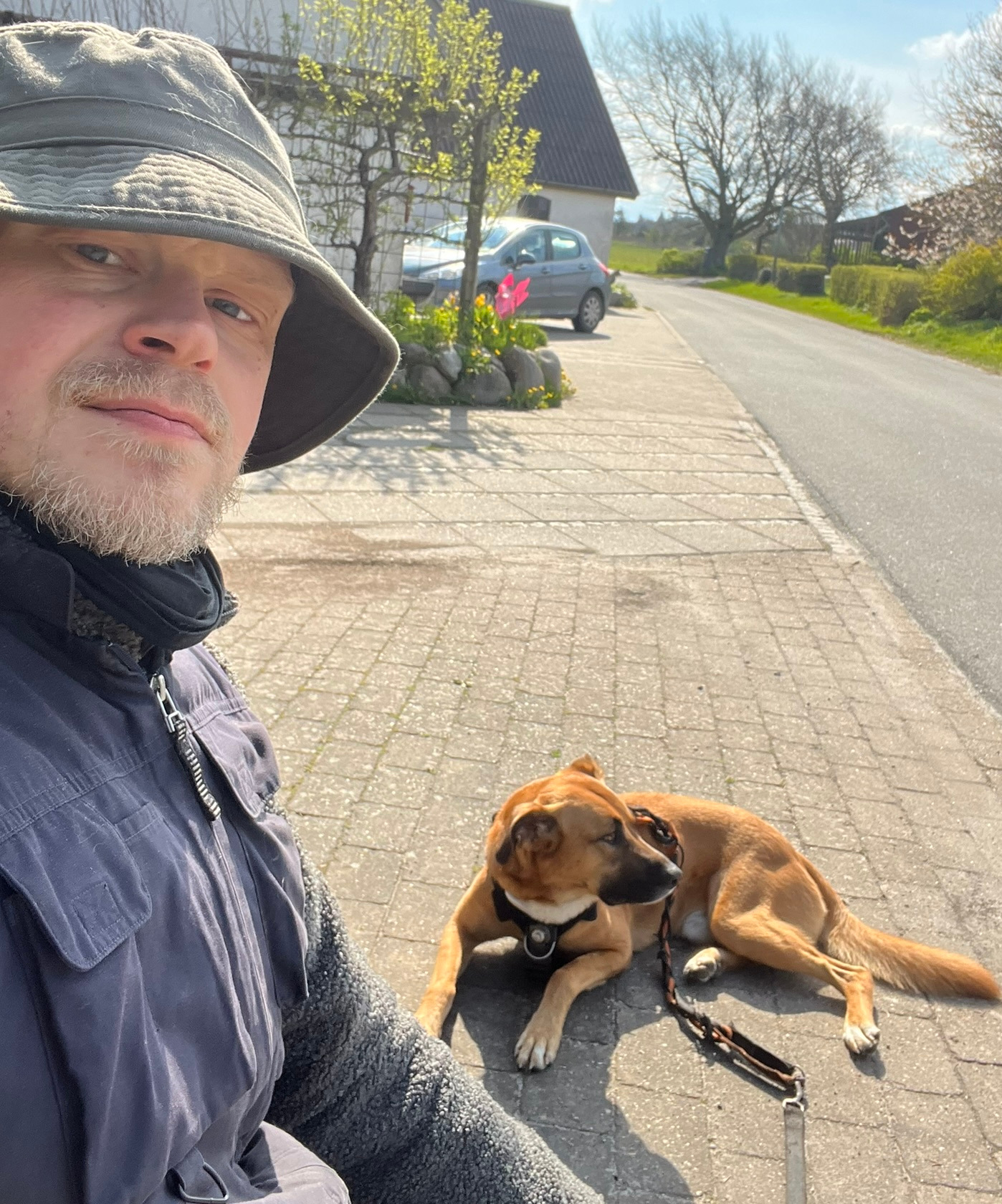
<p><img src="/assets/images/2024-04-martin-and-rolf.jpg" alt="The author and his dog" /></p>
<div class="footnotes" role="doc-endnotes">
  <ol>
    <li id="fn:1" role="doc-endnote">
      <p>Granted, it <strong>is</strong> my own vacation days. <a href="#fnref:1" class="reversefootnote" role="doc-backlink">&#8617;</a></p>
    </li>
  </ol>
</div>]]></content><author><name>Martin Andreas Andersen</name><email>martin.andreas.andersen@gmail.com</email></author><category term="social" /><category term="work," /><category term="emotional" /><category term="labor" /><category term="social-work," /><category term="mental-health" /><summary type="html"><![CDATA[I should have been at work today.]]></summary></entry><entry><title type="html">My experiences with computational sociology (so far)</title><link href="https://martinadreasandersen.com//my-experiences-with-computational-sociology-so-far/" rel="alternate" type="text/html" title="My experiences with computational sociology (so far)" /><published>2020-06-24T04:37:59+02:00</published><updated>2020-06-24T04:37:59+02:00</updated><id>https://martinadreasandersen.com//my-experiences-with-computational-sociology-so-far</id><content type="html" xml:base="https://martinadreasandersen.com//my-experiences-with-computational-sociology-so-far/"><![CDATA[<p>I have been spending my spring ploddingly pursuing my master’s thesis.
Inspired by my visit to the NLP crowd, I’ve undertaken a text-mining project, where I’m trawling speeches in the Danish parliament for education generally, and secondary education specifically.
If possible, I’m looking to tease out relationships between academic and vocational tracks in upper secondary education.</p>

<h1 id="the-road-thus-far">The road thus far</h1>

<p>Apart from the apocalypse bingo card being full ten times over in 2020, this has (and still is, to some extent) been slow going.
The <a href="https://gitlab.com/maltelau/folketinget/">dataset I’m using</a> contains over 700 000 speeches; and this poses certain computational challenges, shall we say<sup id="fnref:server" role="doc-noteref"><a href="#fn:server" class="footnote" rel="footnote">1</a></sup>.
But, I have prevailed somewhat nonetheless.
So far I have:</p>

<ul>
  <li>Cleaned and preprocessed the text</li>
  <li>Run an LDA model fitter to determine an appropriate amount of topics</li>
  <li>Run the LDA model on the corpus, twice. <a href="https://ldavis.andersens.xyz">Got this nifty visualization out of it</a>.</li>
  <li>Discovered that my parameters were off, resulting in a lot of noise in e.g. many procedural boilerplate topics generated. So I get to iterate! Yay science!</li>
  <li>But also! Seen trends over time, consistent with the rise of neoliberalism in the 90s, and a focus on individual attainment in the 00s, for example. There is a <em>there</em> there.</li>
  <li>Become a lot! more comfortable programming. Tidyverse functionals? <code class="language-plaintext highlighter-rouge">data.table</code> and parallel processing black magic? Yup.</li>
</ul>

<p>But one of the biggest takeaways is: All (social, at least) research is subjective, and thus susceptible to researcher bias.
Even ones that involve a lot of numbers and maths.
Those off-seeming parameters above?
There is no Goldilocks answer — all I can do is fiddle with the settings until it seems fine.</p>

<div class="footnotes" role="doc-endnotes">
  <ol>
    <li id="fn:server" role="doc-endnote">
      <p>For more on how I overcame these challenges somewhat, feel free to check <a href="https://norseghost.com/posts/dl380e-g8/">the other blog</a>. Spoiler: it gets nerdy. <a href="#fnref:server" class="reversefootnote" role="doc-backlink">&#8617;</a></p>
    </li>
  </ol>
</div>]]></content><author><name>Martin Andreas Andersen</name><email>martin.andreas.andersen@gmail.com</email></author><category term="sociology" /><category term="education" /><category term="computational sociology" /><category term="machine learning" /><category term="university" /><summary type="html"><![CDATA[I have been spending my spring ploddingly pursuing my master’s thesis. Inspired by my visit to the NLP crowd, I’ve undertaken a text-mining project, where I’m trawling speeches in the Danish parliament for education generally, and secondary education specifically. If possible, I’m looking to tease out relationships between academic and vocational tracks in upper secondary education.]]></summary></entry><entry><title type="html">When did social workers become timid?</title><link href="https://martinadreasandersen.com//when-did-social-workers-become-timid/" rel="alternate" type="text/html" title="When did social workers become timid?" /><published>2019-11-26T00:00:00+01:00</published><updated>2019-11-26T00:00:00+01:00</updated><id>https://martinadreasandersen.com//when-did-social-workers-become-timid</id><content type="html" xml:base="https://martinadreasandersen.com//when-did-social-workers-become-timid/"><![CDATA[<p>I’ve been working with the mentally atypical and disabled for quite nearly two decades.
In this time, I’ve developed a feeling.
A sense of discomfort, discontent, unease.
It was not until recently, when I was assigned an article by Søren Langager, that I could articulate my worries.</p>

<p>Langager posits that, in keeping with changing societal discourse concerning welfare, citizenship and integration, the attitudes toward working with the disabled has shifted.
Instead of a duty to ensure development and progress, the pedagogical[^spec] approach is characterized by avoidance of discomfort and timidity.
Which should strike the pedagogically educated oddly.
Surely, pedagogy is in it’s nature transformative and progressive.
Or, at least it should be.</p>

<p>Langager pounces on neuropedagogy as an example of a language of development that is transmogrified into a practice in timidity<sup id="fnref:neuro" role="doc-noteref"><a href="#fn:neuro" class="footnote" rel="footnote">1</a></sup>.
By using terms such as ‘meeting them on their own terms’, practitioners turn to avoiding situations that seem to cause strews or discomfort in their charges.
But surely, change can be uncomfortable, stressful and discomfiting - even positive change?</p>

<p>Of course, this is not a clear cut dichotomy.
I have examples from practice of an understanding of a citizens particular challenges resulting in careful guidance through a stressful transition<sup id="fnref:note" role="doc-noteref"><a href="#fn:note" class="footnote" rel="footnote">2</a></sup> - as well as ‘professional’ timidity in the name of conflict avoidance.</p>

<p>And I would also posit that, while pedagogy is by nature transformative, the range and scope of the change sought effected is not necessarily great.
Being able to sleep soundly through the night.
Successfully transitioning from leisure to enjoyable activity.
For the neurotypical mind, this discomfiture is managed through a process called ‘growing up’, facilitated by ‘parents’ or other primary caregivers.</p>

<p>For the developmentally atypical, a small change — even a change of environment — can seem insurmountable; the threshold of the unknown a vast and terrible thing.
Sometimes, a calm and guiding force can ease this great uncertainty, lending strength and surety.
But here, I think, we arrive at the crux of the matter: the caregiver must accept the uneven power balance, and, in the immortal words of Uncle Ben, recognize the great responsibility it is to act on behalf of and for the benefit of another<sup id="fnref:power-post" role="doc-noteref"><a href="#fn:power-post" class="footnote" rel="footnote">3</a></sup>.</p>

<p>Without being cognizant of our power and responsibility, and using them to enact change in the world, social workers risk becoming timorous and cowering.</p>

<p>This should not be the actions of my profession, such as it is.</p>

<div class="footnotes" role="doc-endnotes">
  <ol>
    <li id="fn:neuro" role="doc-endnote">
      <p>For a diatribe (in Danish) regarding my thoughts on “neuropedagogy” as a panacea, see essay 2 of <a href="/assets/pdf/uip-portfolio.pdf">this assignment for AU</a>. Spoiler: I am unconvinced. <a href="#fnref:neuro" class="reversefootnote" role="doc-backlink">&#8617;</a></p>
    </li>
    <li id="fn:note" role="doc-endnote">
      <p>A transition from a common pasttime to a truly enjoyable one. A transition that often was fraught, volatile and even violent. But worth it to see the expression of pride and contentment after a successful quest. <a href="#fnref:note" class="reversefootnote" role="doc-backlink">&#8617;</a></p>
    </li>
    <li id="fn:power-post" role="doc-endnote">
      <p><a href="/social-work-and-power-dynamics/">I keep referencing this post on power dynamics</a>. <a href="#fnref:power-post" class="reversefootnote" role="doc-backlink">&#8617;</a></p>
    </li>
  </ol>
</div>]]></content><author><name>Martin Andreas Andersen</name><email>martin.andreas.andersen@gmail.com</email></author><category term="social work" /><category term="sociology" /><category term="professional care" /><category term="special needs" /><category term="power" /><summary type="html"><![CDATA[I’ve been working with the mentally atypical and disabled for quite nearly two decades. In this time, I’ve developed a feeling. A sense of discomfort, discontent, unease. It was not until recently, when I was assigned an article by Søren Langager, that I could articulate my worries.]]></summary></entry><entry><title type="html">The Toll of Emotional Labor</title><link href="https://martinadreasandersen.com//the-toll-of-emotion-work/" rel="alternate" type="text/html" title="The Toll of Emotional Labor" /><published>2019-11-18T00:00:00+01:00</published><updated>2019-11-18T00:00:00+01:00</updated><id>https://martinadreasandersen.com//the-toll-of-emotion-work</id><content type="html" xml:base="https://martinadreasandersen.com//the-toll-of-emotion-work/"><![CDATA[<p>I’ve been doing “emotion work” most of my adult life; a lot of it in assisting the (very) differently abled.
Now, with my transition out from direct emotion work approaching rapidly (I’ll have my last scheduled classes next week), I got to thinking.</p>

<p>This line of work is tough shit, dude.</p>

<h2 id="no-shit-sherlock">No shit, Sherlock</h2>
<p>Now, this is hardly an original thought. I’ve got 5 anecdotes off the top of my head of people transitioning out of caregiving jobs.
My wife is a store assistent.
I am in school; at least one more of my fellow students has the same motivation as I.
I have a colleague who transitioned laterally, from a social advisory role to a more direct caregiving role<sup id="fnref:1" role="doc-noteref"><a href="#fn:1" class="footnote" rel="footnote">1</a></sup>.</p>

<p><a href="http://edu.au.dk/aktuelt/asterisk/magasinetasteriskarkiv/">Asterisk</a>, my faculty magazine, even <a href="http://www.e-pages.dk/aarhusuniversitet/2150/html5/">had the whole last issue</a> related to the concept of “professional care”.</p>

<p>It became particularity clear a couple of days ago, as I was talking to an old acquaintance who shares my line of work.
Or, at least he did.
He (like I did over the winter of ‘15/’16) had had a stress related breakdown; and had changed fields completely.
When the conversation turned to me working nights, he commented that he had done similar things in his career.
A night shift, physical toll notwithstanding, is a way to let down your guard as it were.</p>

<p>Lower those shoulders.</p>

<p>Have a little break from the grind.</p>

<h3 id="a-tour-of-the-salt-mines">A tour of the salt mines</h3>
<p>The kind of emotion work we are discussing can be quite grueling at times.</p>

<p>We work with and assist the most vulnerable and fragile of citizens.
We act as a filter and a bastion against the outside world - a world that can be quite overwhelming for even the most staunch stoic.
We help them navigate their wishes and sometimes conflicting desires.
We try to ensure their days have stability, structure, and purpose<sup id="fnref:2" role="doc-noteref"><a href="#fn:2" class="footnote" rel="footnote">2</a></sup>.</p>

<p>But this can also entail conflict.
For example; when an immediate desire (such as visiting family) is not immediately able to be fulfilled, reactions to disappointment and frustrations can be… counterproductive.
Self-harm and/or <em>externally oriented outbursts</em>, as we euphemistically describe actions that might for all the world seem like physical assault of our bodies.</p>

<p>And thus we must act. Do we flee? Do we embrace? Do we play possum? Do we rebuke?
These, and many more possibilities for action, may be equally appropriate.
Yet we expect of ourselves, both personally and collectively, to be able to let this, too, to pass.
And when all is said and done, to turn the other cheek; maybe even offer a hug and comforting words.</p>

<p>In short; as Hochschild<sup id="fnref:Hochschild" role="doc-noteref"><a href="#fn:Hochschild" class="footnote" rel="footnote">3</a></sup> described in 1979: Our emotional labor — the suppression of unwanted feeling; or the evocation of desired feeling — has been commoditized, as we trade it on the labor market.</p>

<p>Whichever action we chose (in this context, even <em>in</em>action is an action), it is incumbent on us to reflect on and consider them.
Could this be optimized? Could a similar conflict be avoided in the future by choosing different interventions?
This sometimes extends to trying to gauge actions five, ten or fifteen minutes in advance, based on careful reading of the room.</p>

<p>Turns out; this is somewhat exhausting. Add to this personnel shortages; reports to write; food to prepare; meetings to attend; and coffee to drink<sup id="fnref:7" role="doc-noteref"><a href="#fn:7" class="footnote" rel="footnote">4</a></sup>.</p>

<h2 id="and-yet-we-persist">And yet we persist</h2>
<p>So why keep it up?
The answer, for some, is… not to.
I, for instance, moved to the night shift, and then grad school simultaneously.
Granted, I wish to put my continuing education to use in furthering the efforts of those still on the front lines of the welfare state.
Others burn out.
Some change careers; some change workplaces; some scars of the soul never heal<sup id="fnref:3" role="doc-noteref"><a href="#fn:3" class="footnote" rel="footnote">5</a></sup>.</p>

<p>But some stick it out.
The reasons range, I presume, from the practical (this is the job I’ve got, and money is nice, i guess) to the ideological (the premise and promise of the welfare state demands that we step into the breach!), which seems like a plausible continuum<sup id="fnref:4" role="doc-noteref"><a href="#fn:4" class="footnote" rel="footnote">6</a></sup>.
Motivations may well be more mundane, like a welcoming smile, or a heartfelt welcome.
Or a feeling that the sword’s edge was successfully balanced, with no one slipping and falling today.</p>

<p>There are some who posit that work such as this should be rewarding in it’s own right<sup id="fnref:6" role="doc-noteref"><a href="#fn:6" class="footnote" rel="footnote">7</a></sup>.
To plant a seed and let it grow, as it were.
I call bullshit — I do not believe the world can ever send as much back as is required of us to give.
Although there <strong>is</strong> value in completing a difficult task, and doing so competently.
A job well done, with a support network to back it up, both professionally and privately.
In particular, giving room for self care, which <a href="http://edu.au.dk/aktuelt/asterisk/vis-artikel/artikel/har-du-maerket-dig-selv-i-dag/">is explicitly brought up</a> in the aforementioned issue of Asterisk.
I routinely politely ignored my colleagues at break time — not because I didn’t like them; I was simply peopled out, and needed to stare at my phone for 30 minutes.</p>

<div class="footnotes" role="doc-endnotes">
  <ol>
    <li id="fn:1" role="doc-endnote">
      <p>In Denmark, there is a distinction between a <em>socialrådgiver</em>; who typically is affiliated with social offices, and <em>(social)pædagoger</em>, who chracteristically work in street programs or assisted living/work programs. The connotations of the English term <em>scial worker</em> maps somewhat imprecisely to both professions, depending on context. <a href="#fnref:1" class="reversefootnote" role="doc-backlink">&#8617;</a></p>
    </li>
    <li id="fn:2" role="doc-endnote">
      <p>Yes, this implies an uneven power dynamic in the relationship. <a href="/social-work-and-power-dynamics/">See my previous post</a> for my thoughts on this issue. <a href="#fnref:2" class="reversefootnote" role="doc-backlink">&#8617;</a></p>
    </li>
    <li id="fn:Hochschild" role="doc-endnote">
      <p>Hochschild, A. R. (1979). Emotion Work, Feeling Rules, and Social Structure. American Journal of Sociology, 85(3), 551–575.  https://doi.org/10.1086/227049 <a href="#fnref:Hochschild" class="reversefootnote" role="doc-backlink">&#8617;</a></p>
    </li>
    <li id="fn:7" role="doc-endnote">
      <p>Some days, there is not enough coffee. <a href="#fnref:7" class="reversefootnote" role="doc-backlink">&#8617;</a></p>
    </li>
    <li id="fn:3" role="doc-endnote">
      <p>PTSD is a recurring theme in the union magazine. <a href="#fnref:3" class="reversefootnote" role="doc-backlink">&#8617;</a></p>
    </li>
    <li id="fn:4" role="doc-endnote">
      <p>Now there’s a research idea. <a href="#fnref:4" class="reversefootnote" role="doc-backlink">&#8617;</a></p>
    </li>
    <li id="fn:6" role="doc-endnote">
      <p>Even to the point of arguing that the wages be lower. <a href="#fnref:6" class="reversefootnote" role="doc-backlink">&#8617;</a></p>
    </li>
  </ol>
</div>]]></content><author><name>Martin Andreas Andersen</name><email>martin.andreas.andersen@gmail.com</email></author><category term="sociology" /><category term="personal" /><category term="social work" /><category term="emotional labor" /><category term="special needs" /><summary type="html"><![CDATA[I’ve been doing “emotion work” most of my adult life; a lot of it in assisting the (very) differently abled. Now, with my transition out from direct emotion work approaching rapidly (I’ll have my last scheduled classes next week), I got to thinking.]]></summary></entry><entry><title type="html">Gatecrashing the NLP party</title><link href="https://martinadreasandersen.com//gatecrashing-the-nlp-party/" rel="alternate" type="text/html" title="Gatecrashing the NLP party" /><published>2019-11-10T22:19:25+01:00</published><updated>2019-11-10T22:19:25+01:00</updated><id>https://martinadreasandersen.com//gatecrashing-the-nlp-party</id><content type="html" xml:base="https://martinadreasandersen.com//gatecrashing-the-nlp-party/"><![CDATA[<p>OK, so I didn’t really crash any gates.
I did, however, have the chance to attend a <a href="http://interactingminds.au.dk/events/single-events/artikel/nlp-workshop-imc-fall-2019/">workshop on natural language processing</a>, hosted by the <a href="http://interactingminds.au.dk/">Interacting Minds Centre</a> at Århus University.
While a lot of the presentations went a bit over my head, it was all very interesting, and whet my appetite for applying NLP and machine learning in my sociological research.</p>

<h2 id="primary-takeaways">Primary takeaways</h2>

<h3 id="data-is-messy">Data is messy</h3>
<p>No, really.
<strong>Data is messy.</strong>
Take, for a practical example, scraped Twitter data.
Do you strip all punctuation?
This means you lose <code class="language-plaintext highlighter-rouge">#hashtags</code> and <code class="language-plaintext highlighter-rouge">@mentions</code> too.
Do you normalize common misspellings?
Then social signifiers such as group affiliations and slang might also be lost.
In the end, as with most research, the approach will depend on your research question.
But it will almost always be useful to retain the raw text as part of your data frame, with appropriately treated text as new fields.</p>

<h1 id="the-computer-models-are-only-as-good-as-the-data-used-to-train-them">The computer models are only as good as the data used to train them</h1>
<p>Thus, when trained on corpora such as newswire feeds or Wikipedia articles, any bias in the corpus will be reflected in the model.
The typical example: If <code class="language-plaintext highlighter-rouge">king</code> minus <code class="language-plaintext highlighter-rouge">man</code> yields <code class="language-plaintext highlighter-rouge">queen</code>; then <code class="language-plaintext highlighter-rouge">doctor</code> minus <code class="language-plaintext highlighter-rouge">man</code> yields… <code class="language-plaintext highlighter-rouge">nurse</code>.
Yeah.
Not great.</p>

<h3 id="machine-learning-models-want-data">Machine learning models want data</h3>
<p>No, more data.
Go on, don’t hold back…
This will be an issue when working with small languages such as Danish.
A lack of available training data means less robust models.</p>

<h3 id="computer-simulations-can-give-useful-insights-into-human-cognition-and-interaction">Computer simulations can give useful insights into human cognition and interaction</h3>
<p>Two presentations in particular underscored this point:
Felix Günther, who argued that semantic analysis could give an insight into how humans understand and generate meaning;
And Kristian Tylén, who modeled increased problem solving efficiency in groups when the individual agents were dissimilar.</p>

<h3 id="i-feel-somewhat-cheated-of-academic-impact">I feel somewhat cheated of academic impact</h3>
<p>A couple of the presentations were from bachelor’s students presenting novel approaches and new research.
For example, <a href="https://tidsskrift.dk/lwo/article/view/115711">SENTIDA</a>, an <a href="https://github.com/Guscode/Sentida">R package</a> providing sentiment analysis of danish prose.
I am already contemplating the implications for educational sociology.
An analysis of assessments, guidelines and policy documents regarding education and/or social issues?
Or analyzing the debates in the Danish Parliament over such issues?
Something made possible, incidentally, by another student project presented at the seminar, which aims to catalog all parliamentary debates in Europe
(the data is not publicly available yet; but at least the Danish and Czech data had been scraped).</p>

<p>In contrast, my school projects, both from my bachelor’s in social education and my current master course in educational sociology seem rather rote and inconsequential.
Which reminds me of a somewhat disparaging note by a lecturer last semester, comparing the Department of Educational Studies at Århus University rather disparagingly to the kind of school I got my BA at.
Make of that what you will.</p>

<p>(There is, incidentally, a fair bit of literature on the attempted academization of the welfare professions in Denmark, and the relevance and success of this project.)</p>

<h2 id="moving-on">Moving on</h2>

<p>Lest we dwell on that last observation; how do I wish to proceed?
Firstly, I’d like to wedge an NLP approach into my coursework and assignments.
I’m reaching out to the thesis supervisor administrator with my ideas, and I am hoping to utilize a computational approach to a qualitative analysis of text.
The computer is capable of sifting through orders of magnitude more data in a given span of time than myself - such as, for instance, meeting notes or parliamentary debates.</p>

<p>I’d also like to spend some of my limited free time on learner projects, to build familiarity and a little bit of a portfolio.
My first idea is to revisit an assignment from last year; where I attempted a positional analysis of masculinity following the <code class="language-plaintext highlighter-rouge">#thebestamancanbe</code> <a href="https://www.youtube.com/watch?v=koPmuEyP3a0">Gillette ad</a> from January 2019.
A machine learning/NLP approach to this data might be interesting.</p>

<p>Oh, and also brush a lot of dust off my knowledge of applied statistics.</p>

<p>Wish me luck! And also, 48 hour days.</p>

<p>I just might need both.</p>]]></content><author><name>Martin Andreas Andersen</name><email>martin.andreas.andersen@gmail.com</email></author><category term="nlp" /><category term="machine learning" /><category term="sociology" /><category term="personal" /><category term="university" /><category term="rstats" /><category term="python" /><summary type="html"><![CDATA[OK, so I didn’t really crash any gates. I did, however, have the chance to attend a workshop on natural language processing, hosted by the Interacting Minds Centre at Århus University. While a lot of the presentations went a bit over my head, it was all very interesting, and whet my appetite for applying NLP and machine learning in my sociological research.]]></summary></entry><entry><title type="html">Finding a Professional Identity</title><link href="https://martinadreasandersen.com//finding-a-professional-identity/" rel="alternate" type="text/html" title="Finding a Professional Identity" /><published>2019-11-05T00:00:00+01:00</published><updated>2019-11-05T00:00:00+01:00</updated><id>https://martinadreasandersen.com//finding-a-professional-identity</id><content type="html" xml:base="https://martinadreasandersen.com//finding-a-professional-identity/"><![CDATA[<p>Some months ago, I wrote about “developing my sociological identity”.
My interests are (still) solidly interactional, with maybe a slight focus on how individuals react to and within structural concerns.
Granted, this could describe sociology as a whole as well — so I’m maybe not as focused as I thought?</p>

<p>This cornucopia of interests would seem to be a Good Thing, right?
But for someone who is graduating within 8 months, this can also look like vagueness.
Being able to present some sort of clarity of purpose will help both me and a prospective employer decide if we are a match.</p>

<p>Something resembling a professional identity<sup id="fnref:prof" role="doc-noteref"><a href="#fn:prof" class="footnote" rel="footnote">1</a></sup>.</p>

<h2 id="coaching">Coaching</h2>

<p>Luckily, Aarhus University have come to the same conclusions.
Thus, students have the opportunity to get career coaching before graduation.
I chose the course offered by <a href="https://www.stecherinsti.com/">Martabolette Stecher</a>, after perusing the <a href="https://www.stecherinsti.com/">introductory material</a>.</p>

<p>It has been quite interesting so far, about halfway in.
(Re)articulating defining character traits and strengths is all well and good - this is, after all, what I will bring to the table when it comes to employment.</p>

<p>But the real “whoa, dude!” moment came when I was asked to visualize my thoughts for the future on a dreamboard.</p>

<h2 id="its-okay-to-dream">It’s okay to dream</h2>
<p><img src="/assets/images/2019-10_dreamboard.jpg" alt="My dreamboard as of october 2019" class="full" /></p>

<p>Articulating — not to mention dwelling on — my hopes and dreams was quite enlightening.
In my personal life I want some leisure time back.
Going back for a Master’s has meant that I’ve not had time to start an RPG campaign or visit my siblings as often as I’d like, for example.
But I also want more of what I have — family, pets, maybe own a house and drive an electric car.</p>

<p>But the job thing… that was hard to pin down.
I imagined a scenario where I’d get out of the salt mines and into an office.
I do something a lot of people find inscrutable, and it involves a fair bit of computer work.
Thus, the combination of qualitative research, coding in R and Python, but also presentations and meetings and publications.</p>

<p>For this example — I have no knowledge if such a position even exists; much less if I could qualify.
I’d need to do a butt-ton of learning NLP and R, at least…</p>

<p>And that’s just one example. I’d probably be happy many places where I can play on my strengths:</p>

<ul>
  <li>Analytical inclination</li>
  <li>Structured nature</li>
  <li>Desire for actions to have purpose and affect change</li>
  <li>Initiative and drive</li>
</ul>

<p>Which probably is also <strong>why</strong> this aspect has been hard to pin down.</p>

<h2 id="where-to-now">Where to now?</h2>

<p>This week’s assignment is to actively assess possible career choices on three axes:</p>

<ul>
  <li>energy</li>
  <li>competence</li>
  <li>passion</li>
</ul>

<p>And follow this up by actively seeking feedback from people in one’s network on how to proceed.</p>

<p>Current ruminations (after stalking job listings) include</p>

<ul>
  <li>teaching future generations of social workers</li>
  <li>research of some kind, possibly similar to the scenario above</li>
  <li>some sort of work in the administration and directing of social work</li>
</ul>

<p>But the weighting is hard, much less figuring out who to ask for comments.</p>

<p>The future is my canvas. I shall gather my colors.</p>

<div class="footnotes" role="doc-endnotes">
  <ol>
    <li id="fn:prof" role="doc-endnote">
      <p>As expressed by one of my classmates, this is somewhat of a daunting task to undertake on ones own. With my background as a social worker, the job description was also (mostly) <strong>the</strong> professional identity. Not so any more. <a href="#fnref:prof" class="reversefootnote" role="doc-backlink">&#8617;</a></p>
    </li>
  </ol>
</div>]]></content><author><name>Martin Andreas Andersen</name><email>martin.andreas.andersen@gmail.com</email></author><category term="university" /><category term="personal" /><category term="work" /><category term="sociology" /><category term="coaching" /><category term="identity" /><summary type="html"><![CDATA[Some months ago, I wrote about “developing my sociological identity”. My interests are (still) solidly interactional, with maybe a slight focus on how individuals react to and within structural concerns. Granted, this could describe sociology as a whole as well — so I’m maybe not as focused as I thought?]]></summary></entry><entry><title type="html">I Read: editor procastination, make everyone a cheater, and more</title><link href="https://martinadreasandersen.com//weekly-media-week-11/" rel="alternate" type="text/html" title="I Read: editor procastination, make everyone a cheater, and more" /><published>2019-03-18T01:25:40+01:00</published><updated>2019-03-18T01:25:40+01:00</updated><id>https://martinadreasandersen.com//weekly-media-week-11</id><content type="html" xml:base="https://martinadreasandersen.com//weekly-media-week-11/"><![CDATA[<p>Not a lot of links in this list today, partly due to RSS feed cleanup,
partly due to not-as-interesting-to-me stuff crossing my radar.</p>

<h2 id="fiction">Fiction</h2>

<p>I’m still working on <strong>Ship of Destiny</strong>. Not very much progress has been
made, but we’re getting very close to a resolution now.</p>

<p>In TV land, I finished season 3 of <strong>The Magicians</strong>. So angsty! And
magicians truly can be shitty people too… even if they pulled
a <strong>Supernatural</strong> with the finale and leading into nesxt season.</p>

<p><strong>Queer Eye</strong> has a new season out, and it is still very good. Confident
men who wish to empower everyone to be their best selves? Awesome!</p>

<p>Actually got some things from the library read. The initial Batman from
DCs <strong>Earth One</strong> setting (apparently, some sort of althistory take).
Interesting, if maybe a little bit eehh…</p>

<p>But the other pick-up was explicitly up my alley: Don Rosas collected
works, volume 4 (vol 1-3 were, sadly, not available). Leafing through
those stories is reading excerpts from my childhood, cliché and all.</p>

<h2 id="nonfiction">Nonfiction</h2>

<p>I’ve been spending rather more time than probably wise on (neo)vim
threads, procrastinating <em>writing</em> my exam papers by making my editor of
choice more better-er. I’ve still got work to do, though:</p>

<ul>
  <li>I don’t like autocomplete having no delay at all. Should set one at
hmmm, 1 secondds or maybe 2. Also, SuperTab trips me out when I actualy
want to tab sometimes.</li>
  <li>vim-pencil does nice things for my writing environment, but having to
tur it on and off for lists, YAML frontmatter and end-page link sections
is annoying. That toggle needs a hotkey combo, too.</li>
  <li>I need to revisit my keymaps - I have a few I forget to use.</li>
</ul>

<p>But I have found some interesting stories this week. My brother pointed me
to <a href="https://vmcall.github.io/reversal/2019/03/07/exam-surveillance.html">a scathing disassembly of a Danish anti-cheat
system</a>.
Le sigh. Pointless venality, placing everyone under suspicion to catch,
seemingly, 0.5 cheaters per thousand student? Grossly incompetently done?
Yup. Seems like the Danish governing mentality the past decade or so.</p>

<p>Fabio Rojas points to an article (from 2014, no less), <a href="https://orgtheory.wordpress.com/2019/03/12/hermeneutic-institutionalism-what-is-to-be-gained/">about hermeneutic
institutionalism</a>
. The basic gist seems to be, that sociology should, or only could, seek
to uncover processes of meaning and understanding.</p>

<p>Archim Zeileis writes about <a href="https://eeecon.uibk.ac.at/~zeileis/news/endrainbow/">ditching the default rainbow color
palette</a> for data
vizualisations. The examples illustrate quite well how ill-suited the
ever-ubiqutous RGB full saturation approach is. Neither readability nor
accessibility are served many favors.</p>]]></content><author><name>Martin Andreas Andersen</name><email>martin.andreas.andersen@gmail.com</email></author><category term="weekly reading" /><category term="media" /><category term="comics" /><category term="tv" /><category term="style" /><summary type="html"><![CDATA[Not a lot of links in this list today, partly due to RSS feed cleanup, partly due to not-as-interesting-to-me stuff crossing my radar.]]></summary></entry><entry><title type="html">Weekly Media: Academia Blogs Go brrrr</title><link href="https://martinadreasandersen.com//weekly-reading-and-other-media-week-10/" rel="alternate" type="text/html" title="Weekly Media: Academia Blogs Go brrrr" /><published>2019-03-10T03:55:32+01:00</published><updated>2019-03-10T03:55:32+01:00</updated><id>https://martinadreasandersen.com//weekly-reading-and-other-media-week-10</id><content type="html" xml:base="https://martinadreasandersen.com//weekly-reading-and-other-media-week-10/"><![CDATA[<h1 id="fiction">Fiction</h1>

<p>I’m still enjoying the ride as I near the half-way point of <em>Ship of Destiny</em>.
The somewhat large cast, and a spilt narrative perspective, makes for loooong stretches without my favorite characters, though.
And I do see the need to bring new, previously underserved characters into the spotlight, which necessitates putting previous POV characters on a bus (or chained up on a remote island, as it were.
I do wonder what has befallen Kyle Haven…).</p>

<p><em>The Magicians</em> is really quite an enjoyable show.
I’m trying to get back to where I left the third season, and the sardonic realism of this ‘Narnia for Millennials’ is quite entertaining.</p>

<p>I just saw <em>Captain Marvel</em> tonight.
Damn me, but that was a good one.
Cinematically sound, with good pacing, believable characters and an interesting mystery.
And sooo many mythology gags and call-forwards.
Wanna know how Fury lost his eye?
Watch this movie.
Oh, and super badass action woman who takes no shit from the men around her?
Sign me up! Putting this one on my daughter’s Must See list, in a few years’ time.</p>

<h1 id="nonfiction">Nonfiction</h1>

<p>My RSS feeds have been on fire this week — so many stories that have caught my eye.</p>

<p><a href="https://statmodeling.stat.columbia.edu/">Andrew Gelman</a> is <a href="https://statmodeling.stat.columbia.edu/2019/03/03/journalist-seeking-scoops-is-as-bad-as-scientist-doing-unreplicable-research/">continuing his quest</a> to dissuade against <em>defending</em> mistakes in scientific research, so as not to lose the ‘scoop’.
Instead, figure out the source of the mistake - poor theory, noisy data, poor coupling between theory and data — so you know how to overcome this mistake in the future.</p>

<p><a href="https://pinecast.com/feed/ashes-ashes">Ashes Ashes</a>, a podcast  I haven’t (yet) listened to, but been linked the <a href="https://ashesashes.org/blog/episode-62-separate-ways/separate-ways-transcript">transcript of one episode</a>, has a discussion on the loneliness epidemic in the western world today.
With terms such as ‘emotonal refugees’, this is quite interesting.
I must admit, becoming more active in my Tae Kwon Do club has made a world of difference in  my life.</p>

<p>What caught my eye, was the discussion of the artificiality of the  selves we construct on social media, and how alienating to our inner selves this can become.</p>

<p>This ties in with my university-assigned reading.
In *In Defense of the Enlightenment’, Todorov tells of Rosseau warning against this very alienation of self if we allow the idea of others’ perception of ourselves dominate our actions.
Thus, increasingly, rendering them increasingly conformist and inconsequential, in our hunger for external affirmation.</p>

<p>From <a href="https://www.insidehighered.com/">Inside Higher Ed</a>, Barbara Fister writes about the <a href="https://www.insidehighered.com/blogs/library-babel-fish/beyond-battle-open-access">shady nature of academic publishing</a>, in the context of the University of California not paying Elsevier for access anymore.
As Barbara notes: Somehow, these companies earn massive profits while academics provide content for free, and, more troubling, soon the data flow of scholarly production may be a source of income.</p>

<p>If you’re not paying, you’re the product being sold.</p>

<p>In <a href="https://www.datacamp.com/community/blog/getting-your-first-data-science-job">another podcast transcript</a>,
I paid close attention to ways into a data science career.
I do not know if I want to go full-on data analysis post-university; but as a methodology this
approach fascinates me.</p>

<p>On the topic of AIs and machine learning, [Awful AI(https://github.com/daviddao/awful-ai) tracks all the ways AI <em>is used today</em>
to affect society negatively in insidious ways</p>

<p>On <a href="https://whatever.scalzi.com/">John Scalzi’s blog</a>, Mallory O’Meara has <a href="https://whatever.scalzi.com/2019/03/05/the-big-idea-mallory-omeara/">a Big Idea piece</a> on her book <em>The Lady from the Black Lagoon</em>, concerning Miliicent Patrick, a female special effects artist (among other things) from the 50s.
Things did not go easy for her, nor for O’Meara, 50 years later.
Sexism and discrimination are still alive today; to think otherwise is folly.</p>

<p>John Warner writes on Inside Higher Ed about <a href="https://www.insidehighered.com/blogs/just-visiting/if-students-arent-flailing-were-failing">embracing the flail</a>.
Overcoming an uncertain process is crucial, he argues, to maximize learning and ensuring the possibility of future growth.
This is heartening, as I currently feel very much like I am flailing wildly re: my exam assignments in Comparative
Educational Studies.</p>

<p>To end on a depressive note: Casey Newton writes about <a href="https://www.theverge.com/2019/2/25/18229714/cognizant-facebook-content-moderator-interviews-trauma-working-conditions-arizona">the secret lives of Facebook
moderators</a>.
Dammit.
Now I hate people again.</p>]]></content><author><name>Martin Andreas Andersen</name><email>martin.andreas.andersen@gmail.com</email></author><category term="books" /><category term="movies" /><category term="tv" /><category term="news" /><category term="sociology" /><category term="weekly reading" /><summary type="html"><![CDATA[Fiction]]></summary></entry></feed>